

May 4, 2026 4:41 PM


 Admin
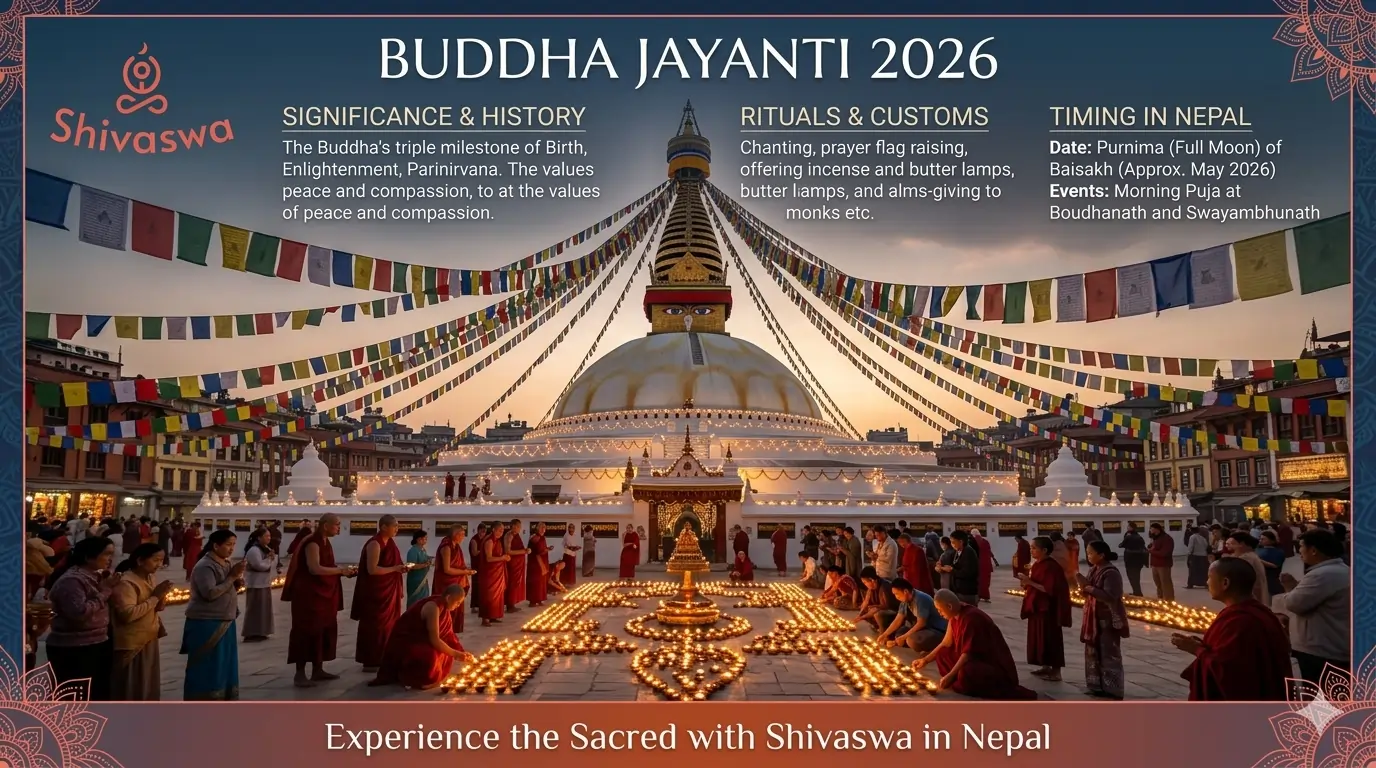
AdminThe air in the Kathmandu Valley is thick with the scent of burning juniper and butter lamps as the full moon of Baisakh approaches. In 2026, Buddha Jayanti (also known as Buddha Purnima or Vesak) falls on Friday, May 1st.
For Nepal, this isn't just a public holiday; it is a profound homecoming. As the birthplace of Siddhartha Gautama, Nepal becomes the global epicenter for the "Triple Blessed Day," a rare spiritual alignment that commemorates the Buddha's birth, his enlightenment (Bodhi), and his final departure from the physical world (Parinirvana).
Whether you are a devout practitioner, a spiritual seeker, or a traveler, this guide provides a deep dive into the rituals, timing, and sacred geography of Buddha Jayanti 2026.
To understand the gravity of Buddha Jayanti, one must look at the three pivotal moments that occurred on the same full moon day over the course of the Buddha's 80-year life.
For 2026, the celebration marks the 2570th Buddha Jayanti, emphasizing a legacy of peace that feels more relevant today than ever.
The rituals of Buddha Jayanti are designed to accumulate Sila (virtue) and Bhavana (mental cultivation). If you are in Nepal during this time, here is how you can participate:
Food on Buddha Jayanti is strictly vegetarian (Sattvic). Many people fast or avoid "the five pungent spices" to maintain a calm mind for meditation.
If you are planning your itinerary for May 1st, 2026, these are the high-energy centers where the celebrations reach their peak.
As the birthplace, Lumbini is the "Ground Zero" for Buddha Jayanti. Expect a grand procession featuring monks from dozens of international monasteries (Thai, Tibetan, Sri Lankan, Burmese). The Maya Devi Temple and the Ashoka Pillar will be the focal points for official government ceremonies and mass chanting.
The massive mandala of Boudhanath becomes a sea of maroon robes and white silk scarves (Khatas). The stupa is freshly white-washed with saffron-water "lotus petals," and thousands of butter lamps are lit at dusk, creating a breathtaking golden glow.
Perched on a hill, Swayambhunath offers a panoramic view of the valley's devotion. It is a unique place to witness the harmony between Hinduism and Buddhism, as both faiths claim the site. The ancient stone steps will be packed with pilgrims carrying incense.
Located about 40km from Kathmandu, this is the site where a previous incarnation of the Buddha sacrificed his body to a starving tigress. It is a powerful location for those looking for a quieter, more meditative atmosphere away from the city crowds.
Traveler’s Tip: Because 2026 falls on a Friday, many locals will take the weekend for a pilgrimage. If you plan to visit Lumbini, book your flights and hotels at least three months in advance, as the region reaches 100% capacity during this period.
Buddha Jayanti 2026 is more than a date on a calendar; it is a live immersion into the philosophy of peace. By following these rituals from eating Kheer to walking the Kora-you aren't just observing a culture; you are participating in a 2,500-year-old lineage of awakening.Plan your journey with us, experience shivaswa the best trekking company in Nepal
FeatureDetails for 2026Official DateMay 1, 2026 (Baisakh Purnima)Primary ThemeTriple Blessed Day (Birth, Enlightenment, Nirvana)Key LocationLumbini, Nepal (UNESCO World Heritage Site)Mandatory DishKheer (Sweet Rice Pudding)Color to WearWhite (Symbol of Purity)
May all beings be happy. May all beings be peaceful. Happy Buddha Jayanti 2026!
Buddha Jayanti 2026 falls on Friday, May 1st. In the Nepali calendar (Bikram Sambat), this is observed on the full moon day of Baisakh (Baisakh Purnima). It is a nationwide public holiday in Nepal, marking the 2570th birth anniversary of Gautam Buddha.
About Buddha Jayanti, it is uniquely significant because three major milestones in the life of Gautam Buddha occurred on the same full moon day: his birth in Lumbini, his attainment of enlightenment (Nirvana) in Bodh Gaya, and his final departure (Mahaparinirvana).
Yes. Lord Buddha was born as Prince Siddhartha Gautama in the sacred gardens of Lumbini, Nepal, in 623 BCE. Today, Lumbini is a UNESCO World Heritage site and the primary destination for pilgrims celebrating Buddha Jayanti in Nepal.
The most common rituals for Buddha Jayanti in Nepali tradition include:
To wish someone a Happy Buddha Jayanti in Nepali, you can say: "Buddha Jayanti ko Subhakamana" (बुद्ध जयन्तीको शुभकामना). This is the most popular way to share Buddha Jayanti wishes with friends and family.
Yes. In Kathmandu, grand processions carry statues of the Buddha around the city. The Boudhanath Stupa and Swayambhunath (Monkey Temple) are the main hubs, where you can witness mass chanting, monastic dances, and the illumination of thousands of lamps at sunset.
On this day, Buddhists typically follow a vegetarian (Sattvic) diet. The most important dish is Kheer, a sweet rice pudding. Sharing this food is a gesture of peace and commemorates the meal that gave Siddhartha the strength to reach enlightenment
.webp)
.webp)


https://experienceshivaswa.com
Install Progressive Web Application
This site has app functionality. Install it on your device for extensive experience and easy access.